The link at “games” is to the NYT op-ed “The importance of recreational math” which deals with the advantages of engaging people with the playful aspects of math. In fact, mathematics has often been called a “game” – but what does this mean?
One interpretation involves the mathematical aspects of some popular puzzles and pastimes. For instance, there are mathematical algorithms to solve Rubik’s Cube, probabilities play an important role in poker, and one needs a good deal of mental dexterity in matching and slotting to be proficient at Sudoku. In this regard, a number of puzzles by the late, brilliant Martin Gardner mentioned in the op-ed require only basic seat-of-your-pants logic, but some involve deeper mathematical principles (you can search for his works on the web, or get one of his many books).
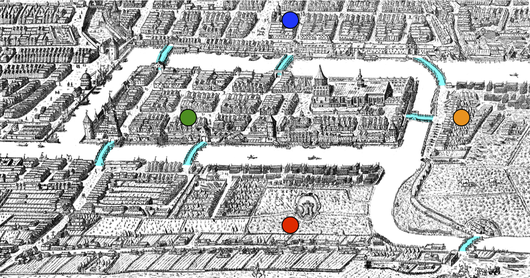
A deeper connection between math and games comes from the true story of how Euler solved the famous “Seven Bridges of Konigsberg” riddle. Inhabitants had wondered for years whether there was a way through town that crossed over each of the seven bridge exactly once (but not more). Although people kept making attempts, such a path had never been found. Euler formulated an ingenious way to solve the problem: realizing that all that mattered were the connections between the different land masses, he abstracted the map as a graph. The river cut the town into four distinct land masses, so he represented each by a dot or vertex. He then drew lines between these vertices to represent the seven bridges connecting them.
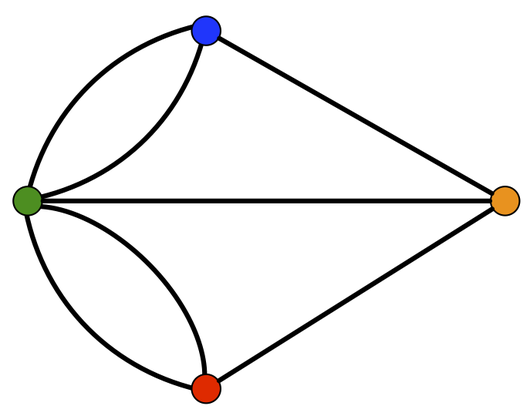
Now the analysis became quite straightforward. Keeping in mind that connections were all that mattered, any route through town could be represented as a path along this graph, and vice versa. If one entered a land mass by a bridge, then one had to leave it by a different bridge, leading to two spokes or edges emerging from the corresponding vertex. If a land mass had a certain number of entries, it had to have the same number of exits, i.e. the number of edges for each vertex had to be even. The only exceptions would be the land mass where the trip began and the one where it ended (which could be the same land mass, of course). In other words, for a path that satisfied the conditions of the riddle to exist, either zero or two vertices in the graph could have an odd number of edges emerging from them, the rest had to have an even number. For Konigsberg, it turned out that all four land masses had an odd number of edges, so such a path could not exist. Euler had proven it so!
But that’s not all. This is where the “game” aspect of math kicked in. Euler could now draw more doodles – arbitrary combinations of vertices and edges. He no longer needed real towns – with his pencil, he could map an endless string of them, with imaginary land masses and imaginary bridges. For each resulting graph, all he had to do was count the number of edges emerging from each vertex to see if a path was possible, in the sense speculated upon by the good townspeople of Konigsberg.
Since Euler’s time, graph theory has become an important, full-fledged field in mathematics. Many connections and relations can be represented by such abstract graphs, and mathematicians have been able to prove various useful results by examining the properties of such graphs. This is one of the most striking examples of how playfully extending simple puzzles into more elaborate games can lead to mathematical discoveries with all sorts of applications.
Exercises: 4. Pittsburgh, PA is the city with the most number of bridges in the US. In the diagram below (picture by Megan DeLaunay), some of these bridges have been marked in purple.
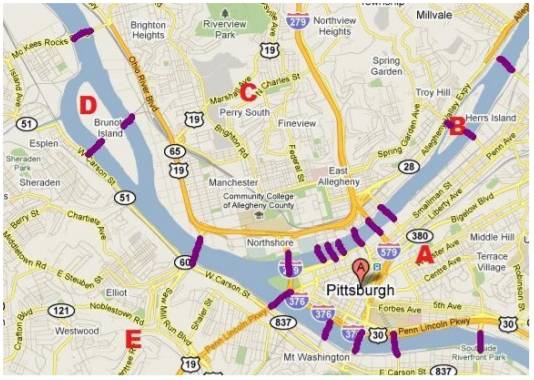
Draw an Euler-type graph using a different vertex for each of the land masses A through E. Hence answer the question whether or not there exists a path through town that traverses each of the above bridges exactly once. Bonus question: Could you start such a walk from any of the land masses A through E?
5. A popular puzzle presented to children is to ask them to draw the figure in Graph 1 without lifting pencil from paper. Use Euler’s ideas to demonstrate whether or not a solution exists.
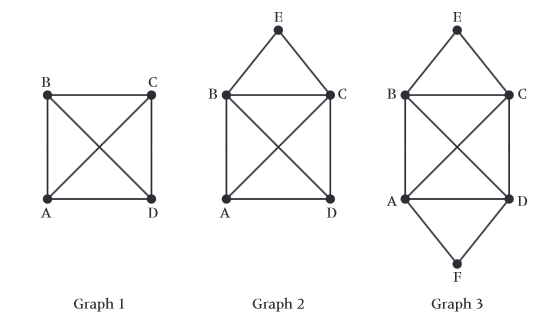
How does the answer change with Graph 2? What further change is seen with Graph 3?
6. The Five Room House Puzzle
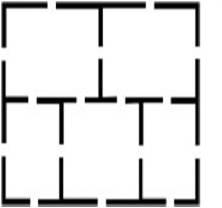
The challenge here is to go through each of these 5 rooms without traversing any door twice, along a path which never crosses over itself. You can start and end in any room, and can also leave and reenter the house. Can you figure out a way, or is this impossible?
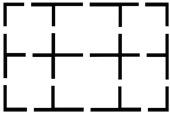
What if you had 6 rooms instead?