Set theory has been part of the mathematics curriculum of many schools for quite some time now. Even those readers who may not have formally encountered it are probably familiar with Venn diagrams showing, for instance, the union or intersection of two sets. The idea is fairly simple: each element is placed either in an overlapping or non-overlapping section, to indicate which set(s) it belongs to.
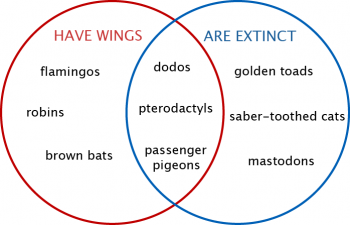
The usual definition of a set introduced in school, “a collection of objects,” is generally good enough for practical applications and Venn diagram illustrations. However, such “naive” set theory starts showing flaws when examined under the exacting illumination of rigorous mathematics.
Here’s the flaw Bertrand Russell discovered. Sets can be of two kinds – those which contain themselves as an element, and those that do not. For instance, “the set of all ideas” is also an idea, so it contains itself as an element. Similarly, “the set of all sets” is a set, and “the set of non-umbrellas” is not an umbrella – so both these sets also belong to themselves as elements.
Suppose now one considers “the set of all sets that do not contain themselves” — call this set A. Does A contain itself as an element or not?
Let’s say the answer is yes, i.e. A is an element of itself. By the definition of A, this means A is a set that does not contain itself. But what this implies is A would not be an element of itself!
So let’s say the answer is no, A is not an element of itself. But this is the exact characterization of sets included in A. So A would be an element of itself!
We see therefore that either way, we get to a contradiction. There’s no way out, really – and the cause is simply this: we were too casual in defining a set as “a collection of objects.” This is what Russell showed with his paradox: to be free of logical inconsistency, one cannot define a set so naively.
After Russell’s paradox became known, logicians worked furiously to repair set theory. They found that the only way to do so was to carefully make a list of basic assumptions called axioms from which everything could be built up without contradictions. This allowed them to design axioms in such a way that Russell’s self-containing sets were excluded from consideration. Further axioms addressed other issues that had been taken for granted so far. For instance, rather than simply invoking an empty set, they added a basic axiom that assumed its existence (or a set of alternative axioms, from which the empty set’s existence could be proved). Similarly, the justification that Professor Ray’s construction of whole numbers could go on indefinitely was provided by an “axiom of infinity” that explicitly declared such an infinite process permissible.
Getting back to the title of this chapter, “creatio ex nihilo” is never quite what it claims – there’s always someone or something lurking in the background that violates true “nihilo.” In religion, this secret ingredient is God, in physics, it’s a singularity, and in mathematics, it’s the empty set. Apparently, you can’t get something out of true nothing.
Exercises: 1. Let A represent the set of even numbers less than 20, B the set of odd numbers less than 20 and C the set of prime numbers less than 20. Draw a Venn diagram showing the intersection of these three sets, with the numbers 1 through 20 positioned inside.
2. There are 29 students in a class. Twenty have dogs and fifteen have cats. Can you represent this information in a Venn diagram? How many students have both cats and dogs? How many have neither? (Follow this link to see different ways of attacking this deceptively simple-sounding problem.)
3. Epimenides, a Cretan, says “Everything a Cretan ever says is false.” Does this necessarily lead to a paradox?
4. On a remote island populated only by men, the barber shaves every single man who doesn’t shave himself, and no one else. Does the barber shave himself? Can this example be framed in a way logically equivalent to Russell’s paradox or is there a difference?
The Big Bang of Numbers (video)