The link at “ideas” is to the NYT op-ed “How to fall in love with math” which argues that the subject can be enjoyed by non-mathematicians if one concentrates on conveying ideas rather than aiming for prowess in calculation.
Discussion: How does that agree with your personal experience? Have you ever had a mathematical idea explained to you without some accompanying calculation that needs to be mastered? Have you ever attempted to actually do such explaining yourself?
The comments received on this op-ed (accessible via the same link) are revealing. While some non-mathematicians responded enthusiastically to the op-ed, others viewed it as yet another attempt by mathematicians to make them feel inadequate. A few expressed a deep sense of anger and frustration. Clearly, people have had awful experiences with mathematics – something that any general interest exposition of the subject needs to be sensitive to.
As far as the mathematical examples in the article go, they all involve infinity in some way: How numbers can be created from nothing is the subject of the next chapter, and fractals are discussed extensively in Part IV of G’s book. So here, let me elaborate on another idea mentioned: that of a circle being the limit of regular equal-sided polygons. This idea can be traced at least far back as Archimedes, who used it to calculate the value of π.
As you know, π is the ratio of any circle’s circumference to its diameter. While the diameter, being a straight line segment, is easy to measure, the circumference, being curved, is harder. Archimedes side-stepped this problem by using formulas rather than actual measurement. Moreover, instead of the circumference of the circle, he used the perimeter of a polygon drawn inside the circle. This perimeter would always be an approximation, but the advantage was that through geometrical arguments, he could express it as an explicit formula.
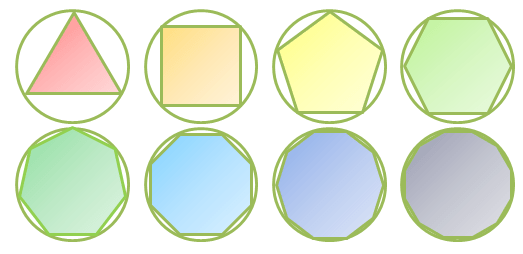
As Archimedes took polygons with more sides, their perimeter became closer to the circumference, yielding increasing accuracy in the calculated values of π. These values were always underestimates, since the polygonal perimeter was always smaller than the circumference. He also repeated the calculation with a sequence of polygons drawn outside the circle. In this case, the perimeter was always larger than the circumference, giving another approximation of π, which was now an overestimate.
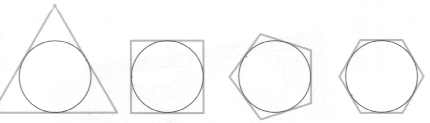
Using these techniques, Archimedes was able to make calculations with polygons with up to 96 sides, and determine that π lay between 3.1408 and 3.1429. These values are quite close to the true value of 3.14159…. For more on Archimedes’ calculation, follow this link.
Exercises: 1. Suppose you could find the area of any triangle, i.e. you had the formula. How you could use this knowledge to calculate the approximate value of the area of a circle, using Archimedes’ idea? The objective would be to once again find an upper value and a lower value such that the circle’s area lay between them.
2. How would you use the above idea to argue that the area of a circle with radius 1 has to be less than 4?
3. Can you extend this idea to three dimensions, and argue that the volume of a sphere of radius 1 has to be less than 8?